
It started with a 10-minute conversation on a Monday morning.
I was chatting with a business owner about something that comes up in almost every business I work with. Their team had frustrations. Repetitive tasks, manual workarounds, broken processes, small inefficiencies that added up. The kind of things that get grumbled about in corridors but never actually reported.
They wanted to ask their team three simple questions:
- Which tasks are you personally doing every week that really shouldn't be on your plate?
- What is one process in the business that is a bit of a mess right now?
- Where would you spend your time if you had an extra 15 hours back each week?
Not IT questions. Business questions. The answers paint a picture that leadership rarely gets to see.
That conversation turned into something I genuinely didn't expect.
The Problem Nobody Talks About
Every business has inefficiencies. Everyone knows it. But almost nobody has a proper way to capture them.
Think about your own team. Someone spends 30 minutes a day manually copying data between two systems. Someone else prints a report, walks it to another department, and waits for a signature. A third person has built an elaborate spreadsheet to work around a system limitation that's been there for years.
These things don't get reported. There's nowhere to report them. No process. No tool. No incentive. So they stay invisible. And invisible problems don't get fixed.
The Maths That Changes the Conversation
One person loses 30 minutes a day to a workaround. Annoying, but manageable. You probably wouldn't even notice it.
But what if 20 people across the business have the same problem?
That's 10 hours a day. 50 hours a week. Over 2,500 hours a year. At an average fully loaded cost of around 20 pounds an hour, that single pain point is costing the business over £50,000 a year.
The problem didn't get bigger. You just couldn't see it before.
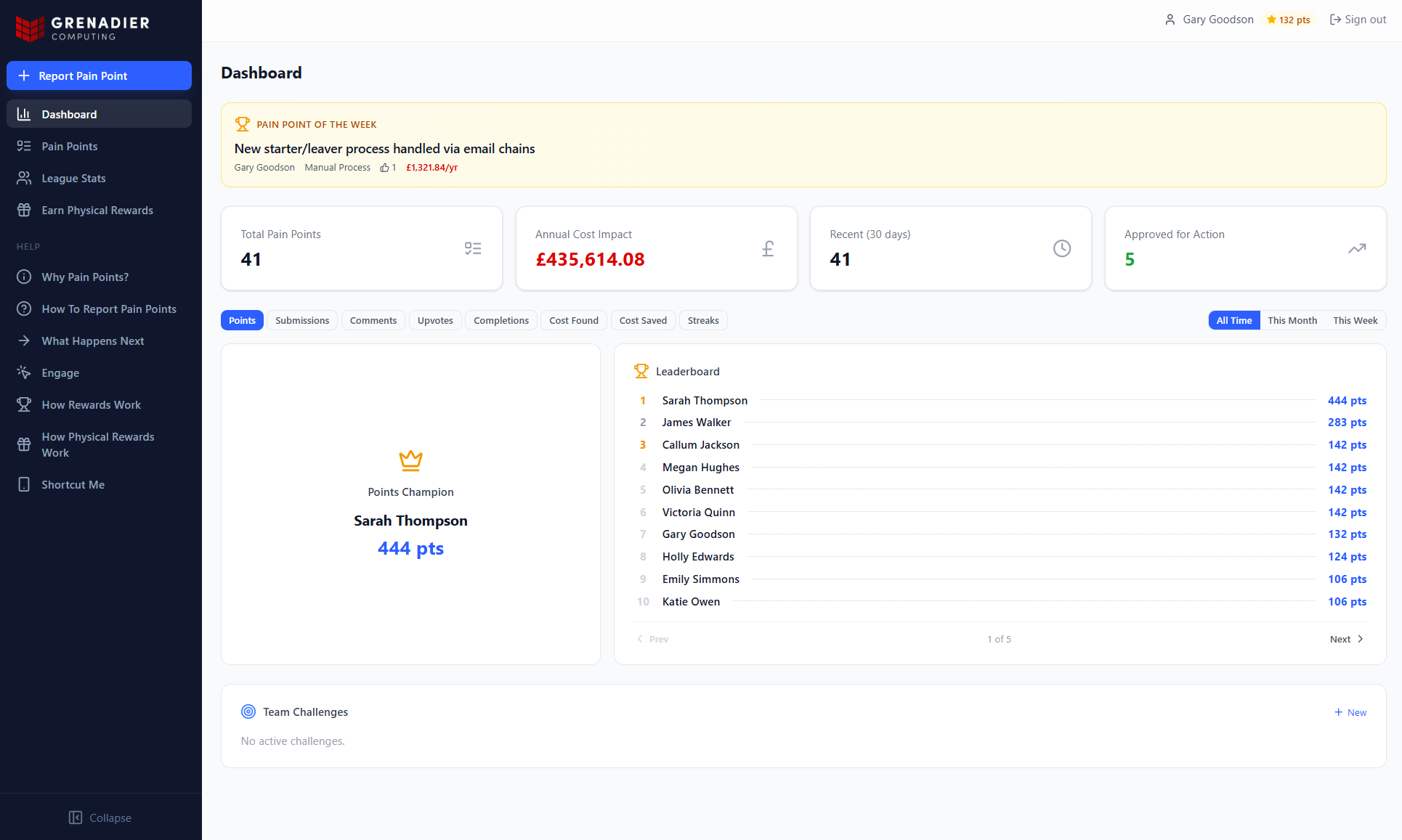
That's what the Pain Points Platform does. Every member of staff can report what frustrates them. What the problem is, how often it happens, how long it takes each time. The platform calculates what each pain point costs the business annually. When a colleague confirms "I have this too", they get added to the affected users list and the cost scales up.
Suddenly leadership has a dashboard showing exactly where the money is going. Not guesswork. Real data, from the people actually doing the work. You can see exactly how the platform works here.
Reporting Is Only Half the Story
You can build the best reporting tool in the world. If nobody uses it, it's worthless.
This is the problem with most internal tools. They launch with fanfare, get used for a week, and then quietly die. People go back to grumbling in corridors. The data dries up. Leadership loses visibility.
So we built a full gamification layer. Not a gimmick. An engagement engine.
66 badges across 13 categories. Points for submissions, comments, upvotes, completions. Leaderboards with 8 category tabs and time filtering. Login streaks with streak savers. We borrowed from the best consumer apps because the psychology works.
But here's the bit that really makes it land: leadership teams can attach real-life rewards to specific badges. Extra annual leave, experience vouchers, team lunches, tech gadgets. Whatever actually motivates their team. It's customised per customer.
Staff don't just report problems either. They can propose solutions and vote on them. The best ideas surface naturally. And for the sensitive stuff that people won't put their name to, there's anonymous submissions. Those still get captured.
It turns "please fill in this form" into something people genuinely want to use.
How It Actually Works
Each customer gets their own organisation within the platform. Staff log in with their existing Microsoft 365 credentials. No new passwords, no new accounts. Just click and go.
Team members submit their pain points. They describe the problem, how often it happens, and how long it takes. The platform does the cost calculation automatically.
When someone else recognises the same problem, they confirm it. The affected user count goes up. The annual cost recalculates. What looked like one person's minor annoyance reveals itself as a business-wide issue.
Leadership teams manage the entire lifecycle. Every pain point moves from Backlog through to Completed. There's a full impact timeline tracking each one's journey. What was reported, when it was acknowledged, what solution was proposed, and when it was resolved.
It's not a suggestion box. It's a way to see what's actually going on in your business, put a number on it, and do something about it.
The Question
Every business has these hidden inefficiencies. The grumbles in corridors, the workarounds that have become habit, the processes everyone knows are broken but nobody has a way to flag.
How are you identifying the pain points holding your business back?
What started as a tool to help our own managed service clients has since sparked conversations with other MSPs and businesses about how they could use it in their own organisations. That wasn't the original plan. But it tells you something about the problem.
If you want to see what the platform looks like or talk through how it could work for your team, I'd genuinely like to hear from you.